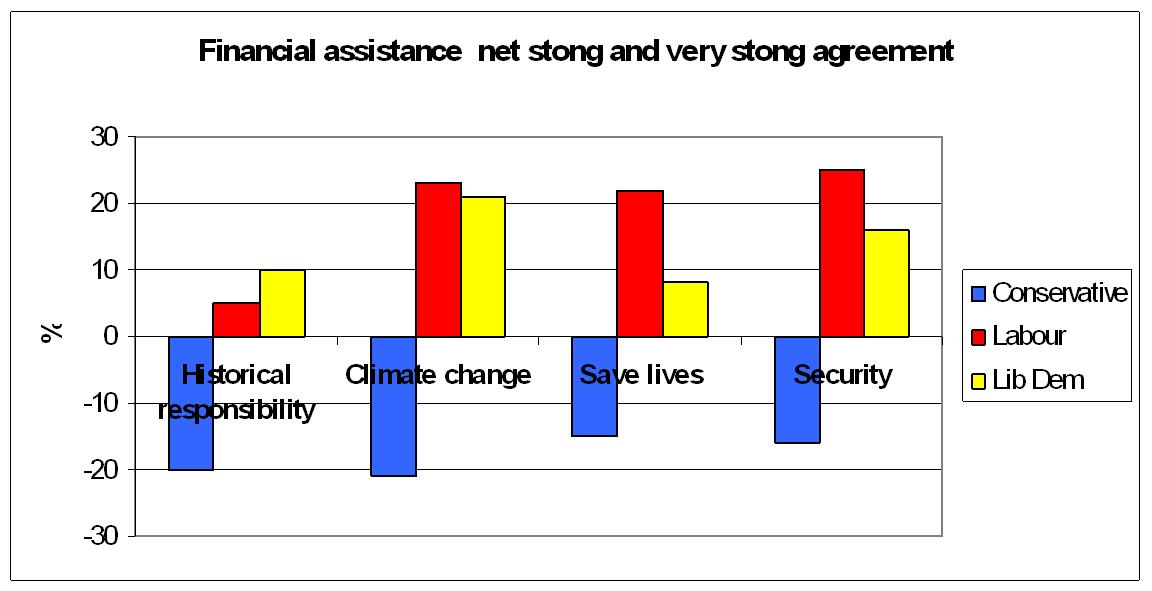
We’ve mentioned before the polling the Institute for Public Policy Research did last year with Brand Democracy, testing out different ways of framing climate policies in 157 marginal constituencies across Britain. Over 3,000 people on YouGov’s panel were surveyed on-line, and the data then weighted by social, demographic and voting patterns. The fieldwork was carried out in September ahead of the party conference season.
Buried in today’s Budget was the Energy Markets Assessment. What is significant about the EMA is that it marks a further implicit shift in UK climate policy away from carbon trading.
The Government has consistently said that the carbon market lies at the heart of its climate policies (for example here and here). But it has also become clear that the EU ETS is failing to create price signals that are credible and long-term enough to guide investment in the power sector. This is why Ed Miliband banned conventional coal-fired new build last year. The EMA acknowledges that the carbon market won’t drive investment Continue reading →
The French Government’s plans for introducing a carbon tax have been dropped, in the wake of regional electoral defeats for Sarkozy and claims that it would harm competitiveness. If carbon trading is hard, carbon taxes appear to be no easier, politically.
Ryan from Australia has pulled us up on the last post, saying it is mistitled: “You have listed a number of interesting and promising developments, but in the end you have said very little about innovation itself. How does innovation actually work?” Our titles are supposed to be witty rather than literal, but in the spirit of following through, this post goes into some of the thinking about the innovation process, and also why we need innovation policy for mitigating climate change.
A key issue at the heart of our last two controversial posts was the potential for innovation in low carbon technologies to delink energy growth (and therefore economc growth) from carbon emissions. One comment accused us of having a “blind faith in infinite innovation”. I wouldn’t quite put it that way, but we do believe that innovation offers the only viable path to mitigation, mainly by making clean energy cheap.
A couple of examples that have come my way in the last couple of days serve to illustrate the point. Continue reading →
Growth isn’t possible (GiP) does raise profoundly serious issues about the limits to economic growth and the need for urgent decarbonisation of energy systems. But part 1 argued that NEF’s approach is seriously weakened by the fudging of energy consumption and carbon emissions in the report, its thin understanding economic growth and its dismissal of innovation.
Environmentalists have always had a problem with economic growth. In the crisis ridden 1970s, the narrative was about the Limits to Growth set by natural resources. In 1980, ecologist Paul Ehrlich made (and lost) a bet with economist Julian Simon that supplies of a number of different metals used in industry would run out and their prices would skyrocket.
There are now similar strands of thought in the peak oil movement. However, this time round the green critique of growth looks a bit more compelling, partly because of the step change in pressure on biodiversity, but of course most of all because of climate change. We all know that carbon emissions are at one level driven by economic growth. Human development is currently abutting a range of biological limits not least the atmosphere’s carbon carrying capacity, which is seriously overstretched. So maybe this time the environmentalists really are right.
This is the substance of the reply I’ve posted on Duncan Green’s blog, From Poverty to Power:
Let’s start with my original post. I didn’t actually say that an increase in taxes on wealth would be “more progressive and transparent” than an FTT. I said that it keyed more directly into a deeper logic. You can dismiss this as an “academic exercise” if you want to; I see the notion that there is a link between historical carbon emissions, the contemporary distribution of wealth and the need to finance adaptation in poor countries not as a “first best solution” to be pronounced in “lofty tones”, but rather as an important broad principle, from which could be developed some powerful political narratives. Historical responsibility is almost always framed in terms of nations, provoking a defensive response, and surely a new perspective that recognises and uses that fact that not everyone in the North has done equally well out of the history of energy intensive capitalist growth could be useful.
Paying for adaptation is going to be a long term issue, and having a campaign that (rightfully) grabs an opportunity (although more on that below) should not be a reason for banning an exploration of wider ideas. OK, so I used the Robin Hood Tax launch as a peg to hang my post on – but, hey, that’s blogging. If a campaign supported by everyone from Bill Nighy to Angela Merkel can be so threatened by some thinking around the issues from an ultimately sympathetic viewpoint, it’s not very robust is it?
Now let’s talk about the politics. You say you see a window for the FTT which isn’t there for a more direct tax on the wealthy. You could be right, but I think there are good counter-arguments. First, in the wake of the financial crisis, people hate bankers, not financial transactions. They want the bankers’ wealth taken away from them. They want financial markets regulated.
Second, and within that mood, increases in taxes on wealth are a real proposition. Despite his embattled political position, Obama is putting forward his proposal to reverse the Bush tax cuts for the wealthy in his Budget.
On the other side of the equation, the incidence issue of a FTT is not just a nerdy debating point for pointy-fingered people, but a potential political weakness. Its opponents could try to make much of the likelihood that the tax will be passed through to ordinary people. Don’t forget that, in addition to the speculators and the banks, a huge range of major companies rely on futures and options to hedge currency risk in international business and trade transactions – the hedgies will pass the tax on to them, and they’ll pass it on to us. Think what the Daily Mail could do with that if it wanted to.
Lastly, however the money is raised, I also think you shouldn’t underestimate the importance of the politics of spending it – the last bone picked with Owen Barder in your post. Last September, we polled over 3,000 people in marginal constituencies to test views on various climate-related policies. Sadly, financial transfers to fund adaptation and mitigation in developing countries had little strong support, which also appeared vulnerable to arguments that corruption will prevent money from reaching the people it should. As you say, Oxfam and others continue to work on the “quality of aid” (as you put it), but I wouldn’t see that as something you should do separately from making the case for a FTT.
I’d like to think that being in favour of an FTT and wanting to develop a wider narrative and additional policy ideas weren’t mutually exclusive. For the record I am happy to get on board the FTT campaign bus. I just don’t want to leave my brain behind.
To avoid a brawl breaking out, we’re drawing a line under this issue now, and moving on to other themes.
My Tobin Tax post yesterday about a wealth tax for adaptation has attracted quite a lot of discussion, which is great. Much of it is along the lines of “interesting idea in theory, but it will never work in practice, unlike the Tobin tax”. The view seems to be that campaigners have been working on the Tobin tax idea for so long, all the angles have been worked out, so the “due diligence” has been done, as Andrew Simms of the New Economics Foundation put it in an e-mail (or at least, that’s what I think he meant….). Not everyone seems convinced – Owen Barder raises problems about tax incidence, and some right wing economists think the whole idea is impracticable and wrong. I guess they would say that wouldn’t they…?
As I said in the post, I’m not against the Tobin Tax, rather, mainly interested in exploring some of the deeper ideas about intergenerational justice and climate change. However, I do take issue Continue reading →
Today’s big news (apart from the fact that we haven’t had a sterling crisis) is the launch of the Robin Hood Tax – aka the Tobin Tax. Having been around for years in the anti-globalisation movement, the idea of a tax on financial transactions was promoted by Gordon Brown and Nicolas Sarkozy amongst others last year as one way of financing transfers to developing countries for adaptation and mitigation. The Copenhagen Accord includes the proposal to find $100 billion a year. The Robin Hood Tax people say that taxes ranging from 0.5% on transactions in stocks and 0.005% on currency transactions would raise $400 billion a year which would also help end global poverty.
The Tobin tax concept is supported by a wide range of people, for a range of reasons (for example, Paul Krugman seems keenest on its dampening effects on speculation). Leaving aside the issues of how the money is disbursed and spent, I’m pretty well-disposed to it as well, but can’t help thinking that for the purposes of raising finance for adaptation in particular, a straightforward wealth tax might not be better.

 We’ve mentioned before the polling the Institute for Public Policy Research did last year with Brand Democracy, testing out different ways of framing climate policies in 157 marginal constituencies across Britain. Over 3,000 people on YouGov’s panel were surveyed on-line, and the data then weighted by social, demographic and voting patterns. The fieldwork was carried out in September ahead of the party conference season.







 Political Climate